

Traffic Law1 min read
Never pay the full property price merely because the seller shows you a registry or allotment letter. Verify the seller's ownership through the relevant government authority, check the land records and mutation, investigate mortgages and court restrictions, confirm society/project approvals, physically inspect the property, and complete the transfer through the official process.

Never pay the full property price merely because the seller shows you a registry or allotment letter. Verify the seller's ownership with the relevant government authority, check the land records and mutation, investigate any mortgages and court restrictions, confirm society/project approvals, physically inspect the property, and complete the transfer through the official process.
Buying a house, plot, apartment, or commercial property can involve years of savings. Unfortunately, property transactions can also involve fake documents, disputed ownership, unauthorized housing schemes, multiple sales of the same property, mortgages, and litigation.
That makes Property Verification Pakistan an essential step before paying a token, advance, or purchase price.
A seller possessing a document does not by itself prove that the entire transaction is legally safe. A buyer should independently verify the ownership record, the seller's identity, the property status, approvals, restrictions, and the official transfer process.
Here is what you should check.
Start with the most important question: Does the person selling the property legally own it?
Do not rely solely on photocopies supplied by the seller or property dealer.
Check relevant records for:
Owner's full name
CNIC details
Property or plot number
Exact area
Khasra, Khewat or Khatooni details where applicable
Ownership history
Any co-owners
Transfer history
In Punjab, for example, the Punjab Land Records Authority (PLRA) describes a Fard as an official document containing information about land, including its area, location, and ownership details. PLRA provides Fard services through Arazi Record Centres and online services.
A registry or sale deed is a critical document, but buyers should verify it through the relevant registration or land-record authority.
In Punjab, PLRA describes registry as the official legal document recording the transfer of property ownership between parties and provides an e-registration process.
Compare the official record with the seller's documents.
Names, CNIC numbers, plot measurements, location, property description and ownership information should match.
A mismatch should be investigated before money changes hands.
Registry and mutation are related but should not be casually treated as the same thing.
Mutation records the change of ownership in the land revenue record following events such as a sale, gift, inheritance or court order.
PLRA states that mutation involves recording the ownership change and official verification by the authorized Revenue Officer. Its process includes checking ownership details such as Khewat and Khatooni against supporting documents.
Therefore, verify whether the seller's claimed ownership is properly reflected in the current revenue record.
Imagine paying millions of rupees and later discovering that the property was mortgaged to a bank or subject to a court stay.
Due diligence should therefore examine whether the property has:
A bank mortgage
Outstanding government dues
A court stay order
An ownership dispute
Transfer restrictions
Pending inheritance claims
Other recorded encumbrances
Punjab's newer Green Property Certificate process is particularly relevant: PLRA says its verification includes ownership history and checks for tax liabilities, bank mortgages and court orders. The process also includes identity verification through NADRA and a physical field survey.
A genuine-looking plot file does not necessarily mean the underlying housing scheme or project is properly approved.
Before purchasing in a housing society or development, verify its status directly with the relevant development authority.
Check:
Society approval/status
Approved layout plan
Exact approved area
Plot location
Development status
Transfer eligibility
Required NOCs
Whether the plot is mortgaged or restricted
CDA specifically warns buyers in Islamabad to check issues such as plots falling in illegally extended areas, changes from approved layout plans, misuse of public amenity land, mortgage plots and building-control requirements.
Documents are only half of due diligence.
Visit the property yourself.
Confirm:
Physical location
Plot dimensions
Boundaries
Access road
Actual possession
Existing occupants
Encroachments
Construction status
For land transactions, a professional survey can be valuable where boundaries are unclear.
PLRA's Green Property Certificate process itself includes a field survey using GPS/DGPS technology to measure the property's boundaries and area, demonstrating why physical verification matters alongside documentary checks.
Make sure the person receiving your money has the legal authority to sell.
Check the seller's original CNIC against the ownership record.
Be especially careful where the transaction involves:
Power of Attorney
Inherited property
Multiple owners
Overseas owners
Corporate ownership
Property belonging to a deceased person
If someone is selling through a Power of Attorney, independently verify that document and confirm that it remains legally operative.
Verification systems differ across Pakistan.
In Punjab, buyers can use PLRA services for land records, Fard, registry and related verification.
Sindh's Board of Revenue provides public land-record searches, including approximately 6 million entries across several record categories. Importantly, the Board itself warns that online information is for public information and has no legal validity, advising people to visit the relevant service centre for accurate records.
In Islamabad, CDA provides an Initial Property Verification Service and formal procedures for property transfers.
This highlights an important rule: use online verification as a starting point, not always as the final legal confirmation.
One of the riskiest mistakes is paying the entire purchase price before completing proper verification and transfer formalities.
A safer transaction should clearly document:
Agreed purchase price
Token/advance amount
Payment schedule
Seller and buyer details
Property description
Deadline for transfer
Responsibility for taxes and fees
What happens if verification fails
Use traceable payment methods and retain receipts.
For high-value transactions, having an independent property lawyer review the documents before substantial payment can be far cheaper than dealing with litigation afterward.
Property verification should never depend solely on what the seller or dealer tells you. Independent verification from the authority maintaining the ownership and transfer record is one of the strongest protections available to a buyer.
Property fraud can turn a dream investment into years of litigation. The safest approach is simple: verify first, pay later.
Check the seller, ownership record, registry, mutation, mortgage status, court restrictions, society approval, and physical property before completing the transaction. Most importantly, conduct verification through the authority responsible for the property's official records rather than relying solely on a dealer, seller or online advertisement.
For further research into Pakistan's property laws, land documentation and legal procedures, use Pakistan Law Bot to explore relevant legislation and legal materials.
Check the relevant land or development authority's official ownership records. The correct process depends on whether the property is in Punjab, Sindh, Islamabad or another jurisdiction.
A registry is important, but buyers should also examine the current land record, mutation, seller's identity, ownership history and any restrictions affecting the property.
PLRA describes a Fard as an official land document containing information such as the property's area, location and ownership details.
Check with the relevant land/development authority and review available encumbrance and ownership records. In Punjab, PLRA states that its Green Property Certificate verification process checks bank mortgages, tax liabilities and court orders.
It is safer to conduct basic verification before making substantial payments. Any token arrangement should clearly state what happens if the property's title or legal status cannot be verified.
Ask our AI assistant or connect with a verified Pakistani lawyer.
Get free legal help
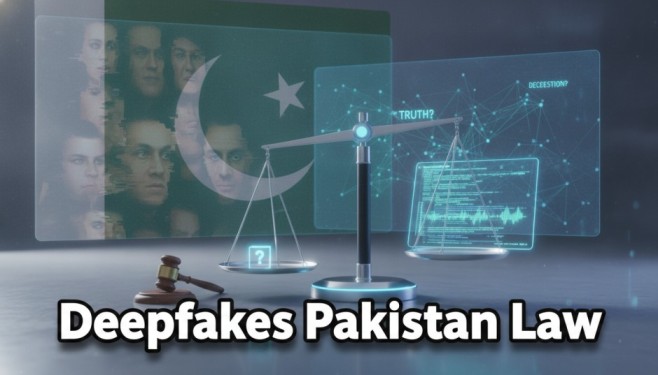
Pakistan's cybercrime law does not specifically define the term "deepfake." However, several provisions of the Prevention of Electronic Crimes Act (PECA)—particularly Sections 20, 24, and the newly introduced Section 26A—may apply depending on how AI-generated fake content is created, shared, or used.
Weekly digest: judgments worth reading, statute amendments, and one product update. No spam.