
General Chatbot vs Legal Chatbot: Which Is Better for Legal Work?
A general chatbot is designed to answer questions across many subjects, while a legal chatbot is designed specifically for legal research, legal documents, legislation, case law, and legal workflows. For legal work, a specialized legal chatbot can be more useful and reliable, but no AI-generated legal answer should be accepted without verifying the underlying law and authorities.
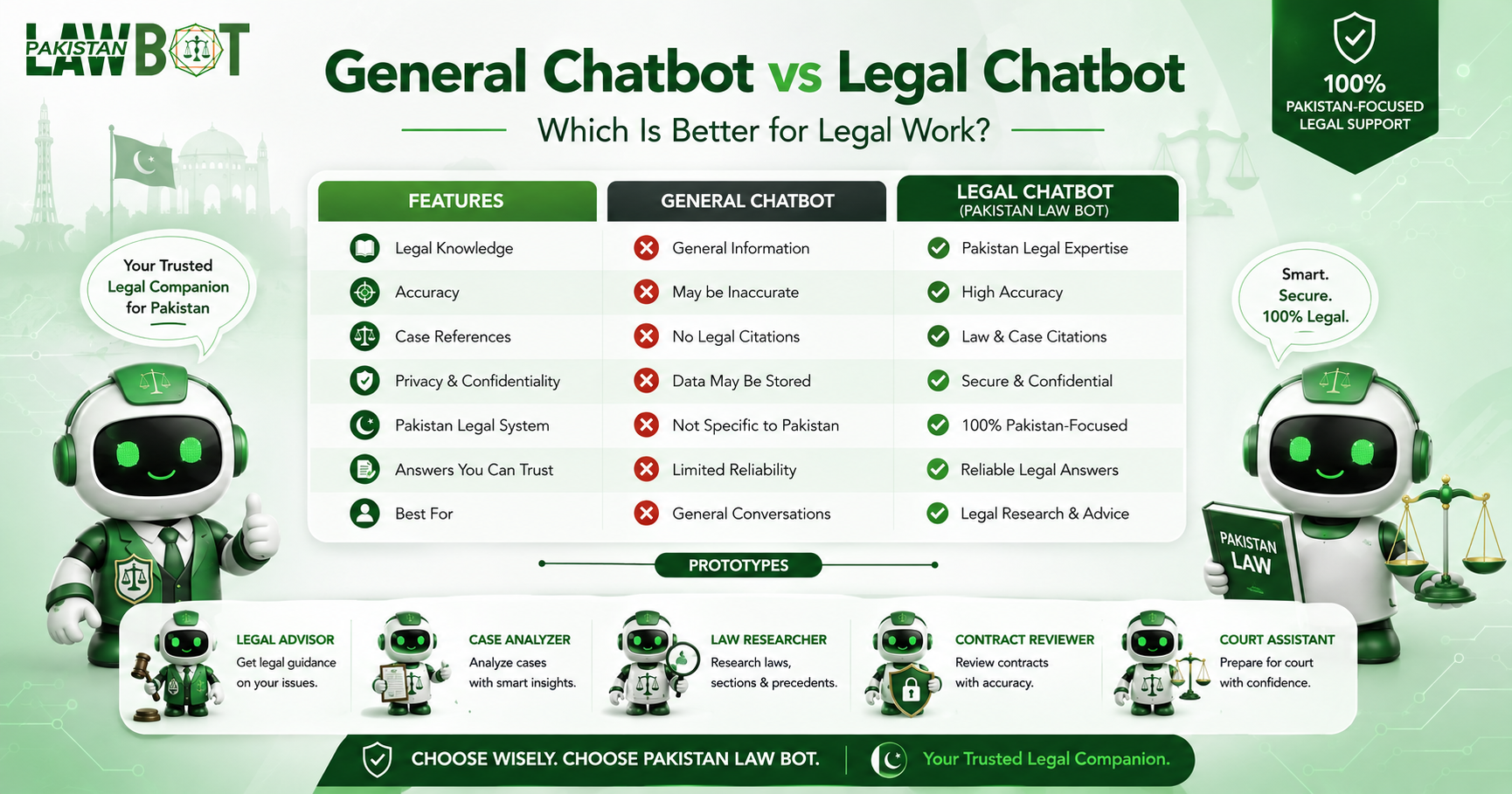
A general chatbot is designed to answer questions across many subjects, while a legal chatbot is designed specifically for legal research, legal documents, legislation, case law, and legal workflows. For legal work, a specialized legal chatbot can be more useful and reliable, but no AI-generated legal answer should be accepted without verifying the underlying law and authorities.
- A general chatbot is designed for broad tasks across many subjects.
- A legal chatbot is designed around legal research and workflows.
- Legal AI can be more suitable for jurisdiction-specific research, judgments, citations, and legal documents.
- General AI remains useful for writing, brainstorming, summarization, and productivity.
- No AI should be treated as automatically authoritative.
- Every important legal citation and authority should be independently verified.
- The best legal workflow combines AI assistance with professional legal judgment.
General Chatbot vs Legal Chatbot: What Is the Difference?
Artificial intelligence has changed the way people search for information. Instead of opening multiple websites and reading dozens of pages, users can simply ask an AI chatbot a question and receive an answer within seconds.
But there is an important distinction that many users overlook:
Not every AI chatbot is designed for legal work.
A general chatbot is built to handle a wide variety of topics such as marketing, education, coding, writing, mathematics, history, business, and everyday questions.
A legal chatbot, on the other hand, is designed around legal use cases. Depending on the platform, it may provide access to legislation, case law, judgments, legal documents, citations, legal research tools, document analysis, and jurisdiction-specific information.
This difference becomes extremely important when the question involves a legal right, court judgment, statute, regulation, or litigation strategy.
What Is a General Chatbot?
A general chatbot is an AI assistant trained or configured to handle a broad range of questions.
For example, you could ask a general chatbot:
“Explain the difference between a civil case and a criminal case.”
It can provide a useful general explanation.
You could then ask:
“Write an email to my client.”
Or:
“Explain this paragraph in simple English.”
Or:
“Summarize this document.”
This flexibility is one of the biggest strengths of general-purpose AI.
However, broad knowledge does not automatically mean legal accuracy.
General generative AI systems can produce answers that sound convincing while containing inaccurate facts, outdated information, or fabricated legal authorities. The American Bar Association has specifically warned lawyers about hallucinations, unreliable outputs, confidentiality risks, and the need for independent verification.
What Is a Legal Chatbot?
A legal chatbot is an AI system designed specifically for legal tasks.
Instead of treating law as just another topic, a legal AI system may be built around specific legal sources, jurisdictions, workflows, and terminology.
For example, a Pakistan-focused legal chatbot may be designed to work with:
Pakistani legislation
Pakistani court judgments
Legal terminology
Case citations
Constitutional provisions
Legal research
Document analysis
Legal drafting
Judgment search
This specialization can make the system much more useful for lawyers who need jurisdiction-specific legal information.
For example, Pakistan Law Bot is designed around Pakistani legal research and provides tools for areas such as judgment search, legal research, drafting, document analysis, and citations.
The key difference is therefore not simply “AI vs AI.”
It is:
General-purpose AI vs jurisdiction-specific legal AI.
General Chatbot vs Legal Chatbot: Key Differences
| Feature | General Chatbot | Legal Chatbot |
|---|---|---|
| Primary purpose | Broad questions and tasks | Legal research and workflows |
| Legal specialization | Limited | High |
| Jurisdiction focus | Usually broad | Can be jurisdiction-specific |
| Case-law research | May be limited | Core use case |
| Legal citations | May generate or summarize | Designed around legal authorities |
| Statute research | General | Specialized |
| Document analysis | General | Legal-focused |
| Legal drafting | Possible | Specialized |
| Legal terminology | Broad understanding | Legal-focused |
| Best use | Everyday AI tasks | Legal work and research |
The important point is that a legal chatbot isn't automatically accurate simply because it has the word “legal” in its name.
The quality of its sources, retrieval system, model, citation process, updates, and verification mechanisms still matters.
Example 1: Asking About Pakistani Law
Imagine a lawyer asks:
“What is the legal procedure for filing a constitutional petition in Pakistan?”
A general chatbot may provide a broad explanation based on its learned information.
It might discuss constitutional jurisdiction, fundamental rights, High Courts, and Article 199.
That answer could be useful as a starting point.
But a lawyer may need much more:
Which constitutional provision applies?
Which court has jurisdiction?
What are the procedural requirements?
Which rules apply?
What recent judgments have interpreted the provision?
Are there limitations or exceptions?
What authorities support the argument?
This is where a specialized legal chatbot can provide greater value.
Instead of simply explaining the concept, the lawyer can use a legal research system to locate relevant Pakistani legal authorities and then verify those authorities.
Example 2: Finding a Relevant Judgment
Consider this question:
“Find Pakistani judgments discussing the principles applicable to bail in a particular criminal matter.”
A general chatbot may explain the principles of bail.
But legal research requires more than an explanation.
A lawyer needs actual judgments.
The lawyer may need:
Case name
Citation
Court
Date
Relevant facts
Legal principle
Relevant paragraph
Whether the judgment is still applicable
A specialized legal research chatbot is better suited to this workflow because finding and analysing legal authorities is part of its intended use.
Example 3: Legal Document Analysis
Imagine a lawyer receives a 50-page contract.
With a general chatbot, the lawyer might upload the document and ask:
“Summarize this contract.”
The AI may produce a useful summary.
But a legal chatbot can potentially take the analysis further:
“Identify termination clauses, indemnity provisions, liability limitations, governing-law clauses and potentially risky provisions.”
The second workflow is much closer to how lawyers actually work.
Instead of simply summarizing text, the AI is being used for a specific legal task.
Which Is More Accurate for Legal Work?
This is where the answer needs some nuance.
A legal chatbot is generally the better choice for specialized legal research.
However, specialization does not guarantee accuracy.
A legal AI can still make mistakes.
The National Center for State Courts warned in its 2026 guidance that AI systems used in legal practice can produce fabricated citations, distorted holdings, and incorrect procedural information.
The American Bar Association has similarly emphasized that lawyers must understand the limitations of generative AI and independently review AI-generated legal work.
Therefore, the better question isn't:
“Which AI never makes mistakes?”
There isn't one.
The better question is:
“Which AI is designed to give me the most relevant and verifiable information for my specific legal task?”
For legal research, a specialized legal chatbot generally has the advantage.
Why General Chatbots Can Be Risky for Legal Research
One of the biggest risks is hallucination.
An AI system may generate a case name, citation, quotation, or legal principle that looks completely legitimate but doesn't actually exist.
This isn't merely a theoretical concern.
In Mata v. Avianca, lawyers submitted court filings containing fabricated case authorities generated by ChatGPT. The incident became one of the most well-known examples of the risks of relying on generative AI without verification.
More recently, legal authorities and courts have continued to warn about fabricated citations and other AI-generated errors.
This leads to one essential rule:
Never cite an AI-generated case, statute, quotation, or legal proposition without checking the original authority.
Does That Mean Lawyers Should Stop Using General AI?
Absolutely not.
General AI can be extremely useful for lawyers.
It can help with:
Brainstorming arguments
Simplifying complex language
Creating first drafts
Summarizing documents
Preparing client-friendly explanations
Generating research questions
Improving grammar
Creating checklists
Organizing ideas
For these tasks, a general chatbot can be an excellent productivity assistant.
The problem begins when users treat it as an authoritative legal database.
A useful way to think about it is:
General AI = versatile assistant
Legal AI = specialized legal research assistant
Lawyer = final decision-maker
The Best Approach: Use Both
The choice doesn't necessarily have to be a general chatbot OR a legal chatbot.
The strongest workflow may combine both.
For example:
Step 1: General AI
Use a general chatbot to brainstorm:
“What legal issues should I investigate in this dispute?”
Step 2: Legal AI
Use a specialized legal chatbot to find:
Relevant statutes
Pakistani judgments
Case citations
Legal principles
Supporting authorities
Step 3: Verify
Open and verify the sources.
Step 4: Apply Legal Judgment
The lawyer evaluates whether the authorities actually apply to the client's facts.
This approach combines AI productivity with legal verification.
What Makes a Good Legal Chatbot?
If you're choosing a legal AI tool, don't judge it only by how impressive its answers sound.
Look for:
Jurisdiction-specific sources
A tool focused on Pakistani law should have strong coverage of Pakistani legal materials.
Reliable citations
The system should make it easy to identify the source behind an answer.
Judgment search
Searching for relevant case law should be a core function.
Document analysis
The system should be capable of analysing legal documents rather than simply summarizing them.
Legal drafting
Drafting assistance can save significant time when preparing repetitive legal documents.
Source verification
The easier it is to trace an AI response back to authoritative material, the safer the workflow becomes.
Data and confidentiality controls
Lawyers should carefully consider what information they upload to any AI system. The ABA has highlighted confidentiality and client-information risks associated with generative AI.
General Chatbot vs Legal Chatbot: The Final Verdict
So, which is better for legal work?
If you want to write an email, brainstorm an argument, simplify legal language, or summarize information, a general chatbot can be extremely useful.
If you need Pakistani legislation, case law, legal citations, judgment research, document analysis, or other specialized legal workflows, a legal chatbot is generally the more appropriate tool.
But neither should replace a lawyer's professional judgment.
The ideal workflow is:
AI → Research → Verify → Analyze → Apply → Decide
Not:
AI → Copy → File
The legal profession is not moving toward a world where lawyers disappear because of AI. It is moving toward a world where lawyers who know how to use AI effectively may have a significant productivity advantage over those who don't.
Conclusion
The debate should not be about whether general AI or legal AI is “smarter.”
The real question is whether the AI is fit for the task.
A general chatbot can be an incredibly powerful assistant, but legal work demands something more than fluent answers. Lawyers need reliable sources, relevant authorities, jurisdiction-specific information, and the ability to verify what the AI is saying.
That is why specialized legal chatbots can offer an important advantage in legal research.
For Pakistani lawyers, the future is likely to be a combination of human legal expertise + specialized AI + authoritative legal sources.
AI can help a lawyer find the answer faster.
But the lawyer still has to make sure it is the right answer.
If you're exploring AI for Pakistani legal research, you can also explore Pakistan Law Bot for judgment search, legal research, drafting, document analysis, and citations.
Frequently asked questions
Is a legal chatbot more accurate than ChatGPT for legal questions?
For specialized legal research, a purpose-built legal chatbot can be more appropriate because it may use jurisdiction-specific legal sources and workflows. However, accuracy depends on the tool's underlying sources, retrieval system, model, and verification process.
Can I use ChatGPT for legal research?
Yes, but it should be treated as a research assistant rather than an authoritative legal source. AI-generated cases, citations, and legal propositions should always be verified against the source. The ABA specifically warns lawyers about inaccurate AI outputs and hallucinations.
Can a legal chatbot replace a lawyer?
No. A legal chatbot can assist with research, drafting, document analysis, and other tasks, but legal strategy, professional judgment, client advice, and responsibility remain with qualified legal professionals.
What is the biggest difference between a general chatbot and a legal chatbot?
The biggest difference is specialization. General chatbots are built to handle many subjects, while legal chatbots are designed to support legal-specific tasks, sources, and workflows.
Should lawyers use both general and legal AI?
Yes. A general chatbot can be useful for brainstorming and communication, while a legal AI can be used for specialized legal research and document workflows. Important outputs should always be verified.
Sources
Need legal help?
Ask our AI assistant or connect with a verified Pakistani lawyer.
Get free legal helpStay ahead with legal insights.
Weekly digest: judgments worth reading, statute amendments, and one product update. No spam.