
How Pakistan Mediated the US-Iran Ceasefire: A Legal & Diplomatic Analysis
A Historic Moment for Pakistan's Foreign Policy On the night of April 8, 2026, Pakistan did something many thought impossible. In a last-minute diplomatic push, Islamabad brokered a two-week ceasefire between the United States and Iran. This happened barely an hour before President Donald Trump's deadline expired, a deadline that threatened to drag the Middle […]
A Historic Moment for Pakistan’s Foreign Policy
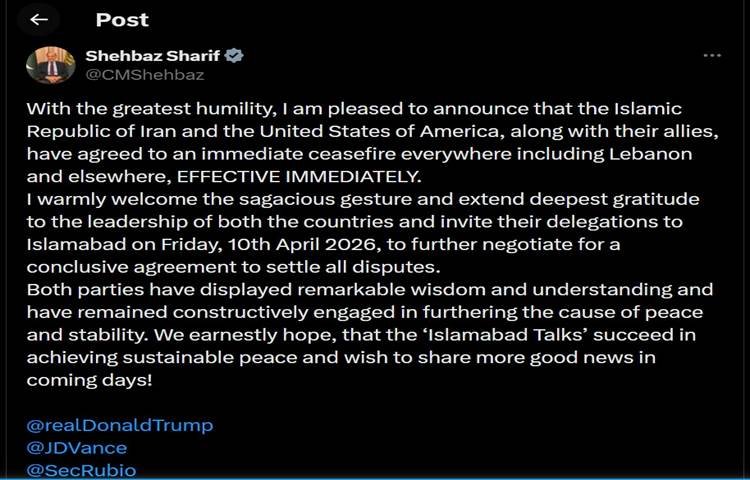
On the night of April 8, 2026, Pakistan did something many thought impossible. In a last-minute diplomatic push, Islamabad brokered a two-week ceasefire between the United States and Iran. This happened barely an hour before President Donald Trump’s deadline expired, a deadline that threatened to drag the Middle East into all-out war.
As a result, this Pakistan-mediated ceasefire now stands as one of the most significant diplomatic achievements in South Asian history. It has shifted Islamabad’s image from a minor regional player to a trusted international peace broker.
For lawyers, legal scholars, and citizens who follow Pakistan law, this event raises important questions. These include issues in international humanitarian law, ceasefire agreements, state sovereignty, the law of neutrality, and diplomatic immunity for the delegations now visiting Islamabad.
Therefore, this article offers a clear legal and diplomatic breakdown of Pakistan’s role. It covers the international legal rules that apply, the rights and duties of ceasefire parties, and what the ‘Islamabad Talks‘ mean for the region and the world.
Background: The Road to Pakistan’s Diplomatic Intervention
1.1 The Conflict’s Origins and Legal Context
The conflict began on February 28, 2026. On that date, Israel and the United States launched strikes on Iran that killed Supreme Leader Ayatollah Ali Khamenei. Under Article 2(4) of the UN Charter, the use of force against another state’s territory is prohibited. In response, Iran struck Gulf nations and Israel, setting off a chain of events across the region.
Consequently, Hezbollah entered the conflict, global energy markets were disrupted, and fears of a wider war grew rapidly. Meanwhile, Pakistan found itself in a unique position. It shares a 909-kilometre border with Iran, yet it also has close ties with Washington. Moreover, Pakistan formally represents Iranian diplomatic interests in the United States — because Iran has no embassy in Washington — giving Islamabad rare access to both sides.
1.2 Pakistan’s Strategic Legal Position as Mediator
Pakistan’s role as mediator rests on several overlapping legal and strategic realities. Together, these factors made Islamabad one of the few countries capable of speaking to both parties:
- Consular representation: Pakistan represents Iranian interests in the US under the Vienna Convention on Consular Relations (1963). This gave it formal communication channels that most other states simply do not have.
- UN Charter obligations: As a signatory, Pakistan supports peaceful dispute resolution under Chapter VI. This gave its mediation international legitimacy.
- Neutrality: By not joining either military camp, Pakistan gained credibility as an honest broker under customary international law.
- Economic self-interest: Pakistan imports much of its oil and gas through the Strait of Hormuz. Furthermore, 5.5 million Pakistanis work in Gulf states. These economic stakes gave the government strong domestic reasons to act.
The Ceasefire Agreement: Legal Nature and Framework
2.1 What Is a Ceasefire Under International Law?
A ceasefire — also called a truce or armistice — is a temporary halt in armed fighting. Under international humanitarian law (IHL), and specifically the Geneva Conventions of 1949, such agreements carry real legal weight. For example, Article 15 of Additional Protocol I requires parties to search for and help the wounded once hostilities pause.
In this case, the US-Iran ceasefire is a ‘partial ceasefire.’ It is limited in time (14 days) and, as discussed below, its geographic scope is disputed. Its legal force depends on whether it was a binding treaty or merely a political promise. This distinction matters a great deal under the Vienna Convention on the Law of Treaties (1969).
2.2 The Lebanon Ambiguity: A Critical Legal Fault Line
A serious legal dispute has already emerged about where the ceasefire applies. Specifically, PM Shehbaz Sharif stated it covered ‘everywhere, including Lebanon.’ However, Israeli PM Benjamin Netanyahu quickly said it did not include Israel’s campaign against Hezbollah there. US Vice President JD Vance echoed that view.
This gap creates a dangerous legal vacuum with immediate humanitarian consequences. Indeed, by April 8, Israeli airstrikes in Lebanon had killed at least 89 people, including medical staff. These strikes may violate several key rules:
- Article 19 of the Fourth Geneva Convention — protection of civilian hospitals
- Article 51(5)(b) of Additional Protocol I — prohibition of disproportionate attacks
- Customary IHL Rule 25 — protection of medical personnel
As a result, Iranian FM Abbas Araghchi raised these violations in a call with Pakistan’s Field Marshal Asim Munir. This raises a further legal question: can Iran legally resume hostilities due to these breaches? Under Article 60 of the Vienna Convention on the Law of Treaties, a material breach by one party can allow the other to suspend or end the agreement.
Pakistan’s Mediation: Legal Framework and Diplomatic Strategy
3.1 International Law Governing Mediation
Several international legal instruments guide Pakistan’s mediation role. First, the Manila Declaration on the Peaceful Settlement of Disputes (1982) affirms every state’s right to use mediation. Second, UN General Assembly Resolution 37/10 actively encourages third-party mediation as a conflict-resolution tool. Third, customary international law sets out the mediator’s duties, including impartiality and confidentiality.
Accordingly, Pakistan’s Ambassador to the US, Rizwan Saeed Sheikh, stated publicly that ‘the success of the negotiation process requires discretion.’ This reflects a well-established mediation principle: keeping talks private protects the space for honest dialogue.
3.2 The Role of Pakistan’s Political and Military Leadership
An unusual aspect of Pakistan’s approach was the direct role of both civilian and military leaders. On one hand, PM Shehbaz Sharif led the political diplomacy. On the other hand, Field Marshal Syed Asim Munir — Chief of Army Staff and Chief of Defence Forces — ran parallel military-to-military talks with US and Iranian commanders. Iranian FM Araghchi personally thanked ‘my dear brothers, PM Sharif and Field Marshal Munir.’
However, this civil-military coordination raises important constitutional questions. Under Article 245 of Pakistan’s Constitution (1973), the armed forces are tasked with defending Pakistan against external threats. Therefore, the CDF’s role in international peace mediation stretches that mandate in new directions — a point that has drawn attention from Pakistan’s legal and political community.
For more on civil-military relations in Pakistan’s constitutional framework, see Pakistan’s Constitutional Framework on Civil-Military Relations
Official Communications: The Tweets That Made History
4.1 PM Shehbaz Sharif’s Ceasefire Announcement
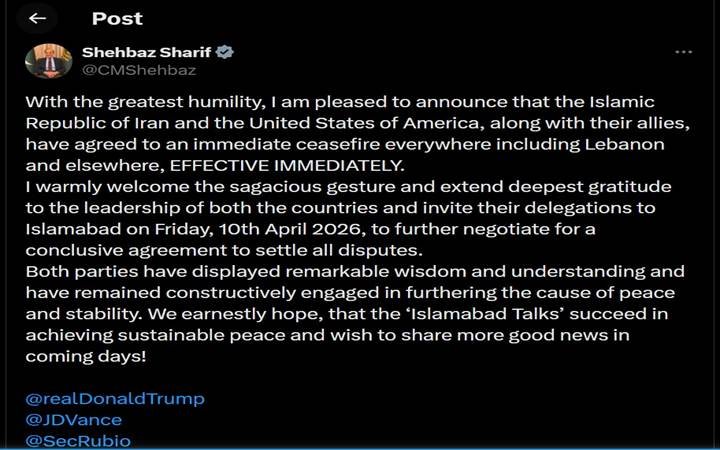
PM Shehbaz Sharif announces the US-Iran ceasefire on X — ‘Effective Immediately’ — April 8, 2026
The Prime Minister’s post was more than a political statement. In fact, under international law, it may carry legal weight on its own. The International Court of Justice (ICJ) held in the Nuclear Tests Cases (1974) that a public declaration by a state official can create binding obligations — even without a formal treaty.
By declaring the ceasefire ‘effective immediately’ and inviting both delegations to Islamabad, PM Sharif made a commitment that the world — and both parties — took seriously.
4.2 Government of Pakistan’s Official Statement
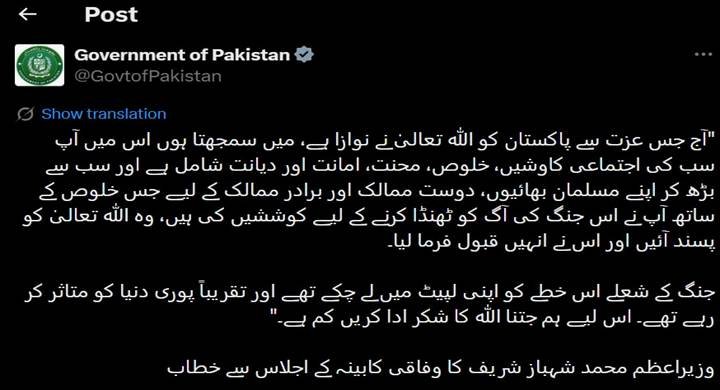
Government of Pakistan’s official Urdu-language statement on the diplomatic achievement — April 8, 2026
The official Urdu statement highlighted the collective effort behind the ceasefire. It noted that the achievement was the result of sincerity, hard work, and prayers. Additionally, it acknowledged Pakistan’s partner nations — Saudi Arabia, Turkey, Egypt, China, Qatar, and Kuwait — for their support. In short, this was not a solo effort but a coordinated regional push.
Global Legal and Diplomatic Recognition
5.1 International Acknowledgement of Pakistan’s Role
The international response to Pakistan’s mediation has been broad and swift. Leaders from every major global bloc have recognised Islamabad’s role. Importantly, this recognition carries implicit legal weight. It confirms Pakistan’s legitimate standing as a mediating state and creates a degree of global accountability for preserving the ceasefire.
| PM Albanese and FM Wong credited Pakistan, Egypt, Turkey and Saudi Arabia as key mediators. | Statement / Acknowledgment |
| United States | President Trump confirmed the ceasefire after talks with PM Sharif and Field Marshal Munir |
| Iran | FM Araghchi thanked ‘dear brothers PM Sharif and Field Marshal Munir’ personally |
| United Nations | Secretary-General Guterres expressed ‘sincere appreciation’ for Pakistan’s efforts |
| United Kingdom | High Commissioner Marriott praised Pakistan’s ‘quiet, effective, diplomatic role’ |
| European Union | Commission President von der Leyen and Council President Costa both credited Pakistan |
| Germany | Chancellor Merz specifically thanked Pakistan for its mediation role |
| Australia | PM Albanese and FM Wong credited Pakistan, Egypt, Turkey and Saudi Arabia as key mediators |
| Kazakhstan | President Tokayev named PM Sharif and Field Marshal Munir directly in his statement |
| Malaysia | PM Anwar Ibrahim praised Pakistan’s ‘Muslim solidarity and international responsibility’ |
The Islamabad Talks: Legal Framework and What to Expect
6.1 Host State Obligations Under International Law
By inviting both delegations to Islamabad, Pakistan took on clear legal duties as a host state. Three main legal instruments govern these duties. First, the Vienna Convention on Diplomatic Relations (1961) requires Pakistan to ensure the safety and inviolability of all diplomatic visitors. Second, the Vienna Convention on the Law of Treaties (1969) will govern any formal agreements that come out of the talks. Third, UN conventions may apply if UN observers attend.
Pakistan has already shown it takes these duties seriously. Interior Minister Mohsin Naqvi met US Ambassador Natalie Baker on April 9 to finalise security plans. Traffic restrictions were placed across Islamabad, and local holidays were declared for April 9-10. The US delegation — led by Vice President JD Vance, Steve Witkoff, and Jared Kushner — will receive full state-level protection.
6.2 The Competing Proposals: Iran’s 10-Point vs the US’s 15-Point Framework
A central challenge for the Islamabad Talks is bridging two very different proposals. As a result, Pakistan’s legal and diplomatic teams face a complex drafting task.
Analysts note these proposals are ‘ at odds’ on core issues. However, the two-week window does give mediators enough time to find common ground — if both sides show flexibility. Pakistan’s role, therefore, is not just logistical. It is also substantive: helping each side understand the other’s red lines.
Key Legal Issues for the Islamabad Talks
- Nuclear Non-Proliferation Treaty (NPT): Iran’s right to civilian enrichment vs. US concerns about weapons-grade development.
- UN Security Council sanctions: Whether these can be suspended through bilateral talks or require a UNSC resolution.
- Strait of Hormuz: Under UNCLOS Articles 37-44, all states have the right of transit passage through international straits. Iran’s closure arguably broke this rule.
- Lebanon’s status: Whether Hezbollah’s activities fall under the US-Iran ceasefire or are treated as a separate legal matter.
Economic and Legal Impact: Pakistan’s Strategic Interests
7.1 Strait of Hormuz and Pakistan’s Energy Security
Pakistan’s push for peace was not purely altruistic. In practice, the country had strong economic reasons to act. Iran’s blockade of the Strait of Hormuz — through which roughly one-fifth of global oil and gas passes — caused direct fuel shortages in Pakistan. Moreover, it disrupted remittances from the 5.5 million Pakistanis living in the Gulf states.
From a legal standpoint, UNCLOS Articles 37-44 guarantee the right of transit passage through international straits. Therefore, Iran’s closure was arguably a breach of binding international law — a point that strengthened Pakistan’s legal case for diplomatic intervention. According to Lloyd’s List, around 800 ships were stuck in the Gulf from late February 2026.
7.2 Implications for Pakistan’s Bilateral Legal Relations
The successful mediation also has clear consequences for Pakistan’s treaties and bilateral ties. Specifically, two key relationships stand out:
- Pakistan-US: The trust built here may open doors to renegotiated trade deals, tariff relief, and stronger defence cooperation frameworks.
- Pakistan-Iran: By serving both sides, Pakistan has deepened its relationship with Tehran — potentially reviving discussions on the long-delayed Iran-Pakistan gas pipeline.
Analysis: What This Means for Pakistan’s Legal and Diplomatic Standing
8.1 Pakistan’s New Role in International Law
Bloomberg put it clearly: Pakistan has shown ‘its repositioning from a peripheral actor to a credible intermediary.’ In legal terms, this shift has real, lasting consequences. States that successfully mediate major disputes tend to gain standing in international forums. They also earn greater influence in treaty-making processes.
Specifically, Pakistan can now expect a stronger influence in bodies like the UN Security Council (consultations), the International Court of Justice (advisory proceedings), and regional groups such as the SCO, OIC, and ECO. Furthermore, its credibility as a neutral party may help in its own disputes — including the long-running tensions with India.
8.2 Domestic Legal Dimensions
Domestically, PM Shehbaz Sharif told his cabinet: ‘Pakistan is a changed country that is viewed with respect across the world.’ This statement has political and legal significance at home. Under Pakistan’s Constitution, foreign policy is the executive’s domain. Nevertheless, parliamentary oversight through the Foreign Affairs Committee remains important. As a result, the government will need to report its mediation commitments fully to parliament.
8.2.1 Civil-Military Coordination
The Field Marshal’s direct role in international peace talks sets a new precedent. However, it also raises questions about the proper limits of military engagement in diplomatic affairs. These are issues Pakistan’s legal community will need to address as this model of civil-military diplomacy develops further.
8.2.2 Public International Law Implications
PM Sharif’s social media posts — declaring the ceasefire ‘effective immediately’ — may carry legal weight beyond their political significance. In the ICJ’s Nuclear Tests Cases (1974), the court held that a government official’s public declaration can create binding international obligations. Accordingly, these posts could be treated as formal state commitments under international law.
Further Reading on Pakistan’s International Legal Commitments
• Vienna Convention on the Law of Treaties — UNTC
• UN Charter — Chapter VI: Pacific Settlement of Disputes
• Pakistan’s Foreign Policy — Ministry of Foreign Affairs
• Pakistan Law Bot — International Law Resources
Conclusion: A Ceasefire, a Changed Pakistan, and the Law Ahead
Pakistan’s mediation of the US-Iran ceasefire is a story of smart, patient diplomacy. A nation of 240 million people — facing economic stress, regional conflicts, and domestic tensions — used its unique position to prevent a potentially devastating war. However, the work is far from over.
For legal practitioners and citizens in Pakistan, the Islamabad Talks will generate important diplomatic and treaty practice. In addition, the debates around ceasefire law, mediation duties, nuclear treaty compliance, and host state immunity will all need clear legal answers in the days ahead.
As PM Shehbaz Sharif said: ‘A ceasefire is the first step, but our destination is lasting peace.’ For Pakistan’s legal community, therefore, this moment is both a challenge and a rare opportunity to shape the country’s international legal identity for years to come.
FAQs – Pakistan US-Iran Ceasefire 2026
Q1: How did Pakistan mediate the US-Iran ceasefire?
Pakistan used its diplomatic ties and role as Iran’s representative in Washington to engage both sides. Shehbaz Sharif convinced the US to extend the deadline, leading to a last-minute ceasefire.
Q2: What legal authority did Pakistan have?
Pakistan relied on UN-backed mediation principles, customary international law, and its role under the Vienna Convention on Consular Relations.
Q3: Is the ceasefire legally binding?
It depends. Under the Vienna Convention on the Law of Treaties, it is binding only if formally agreed as a treaty; otherwise, it’s a political commitment.
Q4: Why is Lebanon a problem?
Pakistan said the ceasefire includes Lebanon, but Israel and the US disagreed. This dispute created legal uncertainty and continued violence.
Q5: What are the Islamabad Talks?
They are US-Iran peace negotiations hosted by Pakistan on April 10–11, 2026, involving senior officials from both sides.
Q6: What are Pakistan’s legal duties as host?
Pakistan must ensure safety, neutrality, and diplomatic protection under the Vienna Convention on Diplomatic Relations.
Q7: Why is Iran’s proposal controversial?
Iran demands sanctions removal and control over the Strait of Hormuz, which conflicts with US conditions on nuclear limits and military presence.
Q8: How does this affect Pakistan globally?
It boosts Pakistan’s credibility as a mediator and strengthens its role in international law and diplomacy.
Q9: Can PM Shehbaz’s posts create legal obligations?
Yes, public statements may create obligations under international law, based on ICJ precedent.
Q10: Where to learn more?
Visit Pakistan Law Bot, the Ministry of Foreign Affairs, and the United Nations resources.
Disclaimer: This article is published by Pakistan Law Bot for informational and educational purposes only. It does not constitute legal advice. Readers should consult a qualified lawyer for advice on specific legal matters. All information is current as of April 9, 2026.
Need legal help?
Ask our AI assistant or connect with a verified Pakistani lawyer.
Get free legal helpStay ahead with legal insights.
Weekly digest: judgments worth reading, statute amendments, and one product update. No spam.