Introduction
Marriage and divorce laws in Pakistan are primarily governed by the Muslim Family Laws Ordinance, 1961 (MFLO). While Section 7 has long regulated the procedure for Talaq, the Muslim Family Laws (Second Amendment) Act, 2021 introduced specific provisions for spouses belonging to Fiqah-e-Jafria (Shia School of Thought).
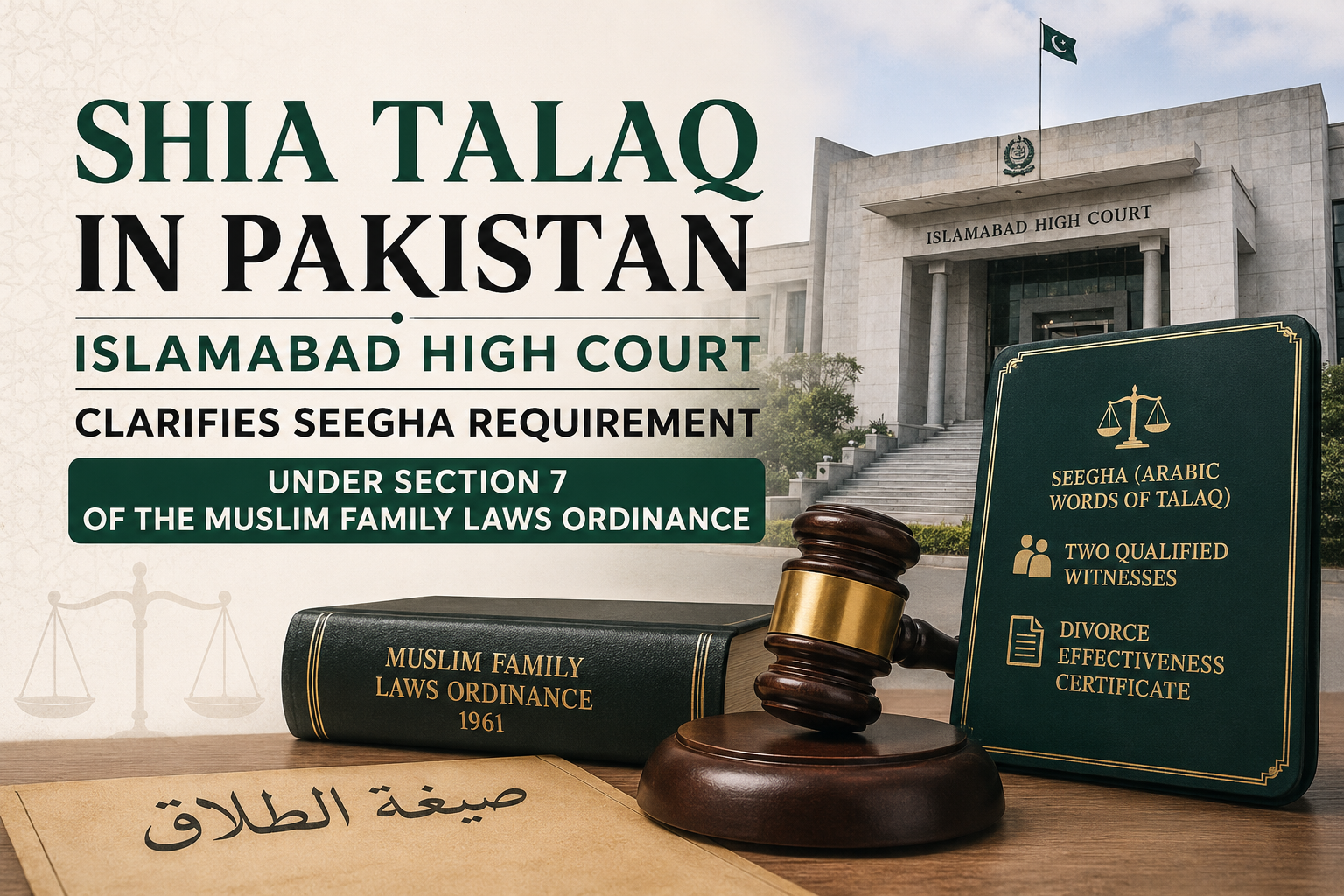
In a landmark judgment (W.P. No. 622/2025 – Bushra Hussain v. Chairman Arbitration Council & Others), the Islamabad High Court clarified that these requirements are mandatory, not optional.
This judgment provides much-needed guidance for Arbitration Councils, legal practitioners, and families dealing with Shia divorce proceedings.
Background of the Case
The petitioner challenged the validity of a Divorce Effectiveness Certificate issued by the Chairman of the Arbitration Council.
She argued that:
-
Both spouses belonged to the Shia (Fiqah-e-Jafria) sect.
-
The mandatory Arabic Seegha of Talaq had never been pronounced.
-
The legal requirements introduced through the 2021 amendment were not fulfilled.
-
Therefore, the Divorce Certificate had been issued unlawfully.
After reviewing the evidence, the Islamabad High Court agreed that the mandatory procedure had not initially been followed.
What Does Section 7 of the Muslim Family Laws Ordinance Require?
For most Muslims in Pakistan, Section 7 requires:
-
Written notice of Talaq to the Chairman of the Arbitration Council.
-
Formation of an Arbitration Council.
-
Reconciliation efforts.
-
Waiting period of 90 days.
-
Issuance of Divorce Effectiveness Certificate if reconciliation fails.
However, after the 2021 amendment, additional requirements apply specifically to Fiqah-e-Jafria marriages.
Special Requirements for Shia (Fiqah-e-Jafria) Talaq
According to the amended Section 7:
The husband must:
-
Pronounce Talaq voluntarily.
-
Pronounce the Arabic Seegha.
-
Do so personally or through an authorized Vakil.
-
Pronounce it before two qualified Muslim witnesses.
-
Avoid pronouncing Talaq under coercion, intoxication, insanity, or anger.
Only after these requirements are satisfied can the divorce become legally effective.
Why Did the Court Declare the Earlier Divorce Certificate Invalid?
The Court observed that:
-
Three written Talaq notices had been issued.
-
None proved that the mandatory Arabic Seegha had been pronounced.
-
The Arbitration Council issued the certificate without verifying compliance.
-
This violated the amended law.
The Court held that written notices alone were insufficient where the parties belonged to Fiqah-e-Jafria.
Is the Word "May" Mandatory or Optional?
One of the most significant legal questions before the Court was whether the word "may" in the amended Section 7 gave husbands discretion.
The Court answered No.
After analyzing principles of statutory interpretation, including:
-
Maxwell on Interpretation of Statutes
-
Crawford on Construction of Statutes
-
Julius v. Lord Bishop of Oxford
-
Pakistani Supreme Court precedents
The Court concluded that "may" must be interpreted as "shall" because the amendment was enacted to protect the legal rights of Shia spouses.
Guidelines Issued by the Islamabad High Court
The Court also issued important directions for all Arbitration Councils.
They must:
Verify the Pronouncement of Seegha
Before issuing a Divorce Effectiveness Certificate.
Confirm Presence of Two Witnesses
Qualified under Article 17 of the Qanun-e-Shahadat Order, 1984.
Accept Religious Verification
Where Seegha has already been pronounced before a recognized religious scholar, appropriate verification may be accepted.
Refuse Certificates Without Compliance
No certificate should be issued until these legal requirements are satisfied.
Why This Judgment Is Important
This decision is important because it:
-
Protects the constitutional right of Shia citizens to follow their personal law.
-
Clarifies the practical implementation of the 2021 amendment.
-
Provides nationwide guidance to Arbitration Councils.
-
Reduces uncertainty in future family disputes.
-
Prevents invalid divorce certificates from being issued.
Case Law Cited by the Court
The judgment relied upon several important precedents, including:
-
PLD 2023 Lahore 38
-
PLD 2025 Lahore 18
-
1984 CLC 1961
-
2006 YLR 1753
-
PLD 1965 West Pakistan Karachi 185
-
2001 SCMR 1001
-
2011 SCMR 420
Conclusion
The Islamabad High Court's decision in Bushra Hussain v. Chairman Arbitration Council & Others (W.P. No. 622/2025) marks a significant development in Pakistan's family law jurisprudence. It confirms that the procedural safeguards introduced by the Muslim Family Laws (Second Amendment) Act, 2021, are mandatory for parties belonging to Fiqah-e-Jafria.
The ruling ensures that Divorce Effectiveness Certificates are issued only after compliance with the statutory requirements, thereby protecting both religious principles and legal certainty.